

A modern approach to shoulder replacement that preserves important shoulder anatomy.
Shoulder replacement surgery can provide substantial pain relief and restore function for patients with advanced shoulder arthritis and other serious shoulder conditions. But not all shoulder replacements are performed using the same surgical approach.
At Sohn Orthopaedics, Dr. Roger Sohn offers a tendon-sparing approach to shoulder replacement designed to preserve the subscapularis tendon, an important structure at the front of the shoulder.
By avoiding the traditional release and subsequent repair of this tendon in appropriately selected patients, tendon-sparing shoulder replacement may allow an earlier return to shoulder motion while eliminating the need to protect a healing subscapularis repair.
What Is Tendon-Sparing Shoulder Replacement?
In many conventional shoulder replacement procedures, the surgeon releases the subscapularis tendon to access the shoulder joint. At the end of surgery, the tendon is repaired and must be protected while it heals.
The subscapularis is one of the four rotator cuff muscles. It helps stabilize the shoulder and rotate the arm inward.
Tendon-sparing shoulder replacement uses a surgical approach that preserves the attachment of the subscapularis tendon.
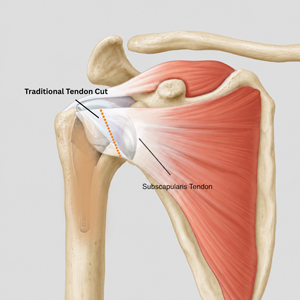
This changes an important aspect of postoperative rehabilitation: because the tendon has not been detached and repaired, recovery does not require the same restrictions intended to protect a healing subscapularis repair.
The procedure still involves replacing the damaged shoulder joint components, just as in conventional shoulder arthroplasty.
Watch: How Tendon-Sparing Shoulder Replacement Works
What Are the Potential Advantages?
1. Preservation of the Subscapularis Tendon
The subscapularis is an important part of the rotator cuff. Preserving its attachment avoids the need for surgical detachment and subsequent tendon healing.
2. Earlier Shoulder Motion
Traditional shoulder replacement protocols commonly restrict certain movements while the subscapularis repair heals.
With Dr. Sohn’s tendon-sparing protocol, appropriately selected patients may begin gentle active and assisted shoulder motion much earlier, sometimes immediately after the regional anesthetic block wears off.
3. Less Dependence on a Sling
Because there is no detached subscapularis tendon requiring protection, some patients may use a sling primarily for comfort during the first one to two weeks rather than requiring prolonged immobilization.
4. A Different Approach to Rehabilitation
Earlier motion may help patients begin recovering functional movement sooner. However, the joint replacement and surrounding tissues still require time to recover, and lifting restrictions remain important.
Important: These are potential advantages of the surgical approach, not guarantees of faster recovery, less pain, or better long-term results. Outcomes depend on the patient’s anatomy, procedure, general health, and rehabilitation.
How Does It Compare With Traditional Shoulder Replacement?
| Traditional approach involving subscapularis release | Tendon-sparing approach | - |
|---|---|---|
| Subscapularis tendon | Released and repaired | Attachment preserved |
| Tendon healing precautions | Typically required | No subscapularis repair to protect |
| Early shoulder motion | Often restricted | May begin earlier |
| Sling | Often used for several weeks | May be used primarily for comfort |
| Rehabilitation | Protects the tendon repair | Individualized early-motion protocol |
Both approaches can provide excellent results. The appropriate technique depends on the type of shoulder replacement, the patient’s anatomy, and the surgeon’s assessment.
What Is Recovery Like?
Dr. Sohn uses an individualized rehabilitation program that takes advantage of the preserved tendon while protecting the new shoulder joint.
For suitable patients, his tendon-sparing protocol may include:
- First 1–2 weeks: Sling for comfort, with early gentle shoulder motion as directed.
- Weeks 0–6: Active, active-assisted, and passive range-of-motion exercises as appropriate, with lifting generally limited to approximately 1–2 pounds.
- Weeks 6–12: Progressive activity and strengthening, with lifting generally limited to approximately 5–10 pounds.
- After 12 weeks: Gradual advancement toward unrestricted use as healing, strength, and function permit.
These are general guidelines. Individual restrictions may differ based on the type of implant, bone quality, additional procedures, and intraoperative findings.
Who Is a Candidate?
Tendon-sparing shoulder replacement may be an option for selected patients who require shoulder arthroplasty for conditions such as advanced arthritis or other significant shoulder joint disorders.
Not every patient is a candidate. Previous surgery, shoulder stiffness, bone deformity, rotator cuff integrity, and other anatomical considerations can affect the choice of approach.
Dr. Sohn evaluates each patient’s imaging, physical examination, symptoms, and goals before recommending a surgical plan.
Experience Matters
Dr. Roger Sohn is a fellowship-trained orthopedic surgeon specializing in shoulder and elbow surgery, with more than 18 years of clinical practice.
At Sohn Orthopaedics, shoulder replacement is part of a comprehensive care pathway that includes preoperative optimization, individualized pain management, surgical planning, rehabilitation, and follow-up.
The goal is not simply to replace a damaged joint, but to help patients return safely to the activities that matter to them.
Frequently Asked Questions
Is tendon-sparing shoulder replacement the same as minimally invasive shoulder replacement?
Not exactly. Tendon-sparing describes the preservation of a specific tendon. It does not necessarily mean a smaller skin incision or less extensive surgery overall.
Does tendon-sparing surgery eliminate the need for physical therapy?
No. Rehabilitation remains important for restoring motion, strength, and function. The main difference is that certain restrictions related to a repaired subscapularis tendon may not be necessary.
Will I recover faster?
Earlier motion may be possible, but that does not guarantee faster overall recovery. Long-term function depends on multiple factors, and comparative clinical evidence continues to evolve.
Is tendon-sparing shoulder replacement right for everyone?
No. The approach must be selected based on the patient’s diagnosis, anatomy, and surgical needs. In some situations, a conventional approach may be more appropriate.
- Explore Your Shoulder Replacement Options
If you’re considering shoulder replacement, understanding the surgical approach is an important part of making an informed decision.
Dr. Sohn can review your imaging, explain whether tendon-sparing shoulder replacement is appropriate for you, and discuss what to expect before and after surgery.
Schedule a consultation with Sohn Orthopaedics in San Juan Capistrano or Newport Beach, California.